
How the Mojave Groundwater Bank Serves Disadvantaged Communities
San Bernardino County’s water providers receive priority access to Mojave Groundwater Bank supply, alongside water reserved for disadvantaged communities.
The Mojave Groundwater Bank, a public-private partnership between public water agencies, Native American Tribes, and Cadiz, is designed to expand access to clean, reliable, and affordable water for underserved communities. Planned infrastructure would supplement existing local supplies. Its County memorandum of understanding (MOU) combines priority rights for San Bernardino County public water systems with a one-time 25,000-acre-foot allocation that qualifying providers can use to serve disadvantaged communities. The local priority puts the project’s home County first as water is contracted for use elsewhere.
Summary
- San Bernardino County public water systems have first priority for Mojave Groundwater Bank annual supply not already under a binding written agreement when a 2023 update to the County MOU took effect.
- The County MOU reserves a one-time 25,000-acre-foot supply for allocation through County procedures, giving qualifying Mojave-region providers a way to serve disadvantaged communities.
- The County MOU also retains a 20-percent reservation of the Mojave Groundwater Bank’s annual yield for future County users over 50 years.
- Cadiz’s additional Tribal partnerships support water access through planned supply and treatment of existing wells, including installed arsenic-removal systems for Torres Martinez community facilities.
County Water Providers Have First Priority for Local Supply
The County MOU gives San Bernardino County public water systems first priority for annual project supply that was not already committed under binding written agreements when the 2023 update took effect. This priority allows County providers to obtain water before Cadiz enters qualifying agreements for beneficial use outside the County.
Cadiz must give the County 60 days’ written notice of a proposed outside-County agreement and provide a copy. The County can designate a local public water system to take that supply on substantially similar terms, including the price. The designated provider must accept those terms and has an additional 60 days to execute a substitute agreement. If the County or its designated provider does not act within those periods, Cadiz may proceed with the proposed outside-County agreement.
The MOU also retains a reservation of 20 percent of annual project yield for future County users over 50 years. The priority right and annual reservation give local providers opportunities to secure a long-term supply through the project.
Reserved Water Helps Providers Serve Disadvantaged Communities
California recognized the human right to water in 2012, including access to safe, clean, and affordable drinking water. The project’s planned supply and infrastructure would help local providers expand water access for disadvantaged communities.
Separate from the annual priority and reservation, Cadiz and Fenner Gap Mutual Water Company reserve a one-time supply totaling 25,000 acre-feet for delivery as San Bernardino County directs. Qualifying public water providers in the Mojave watershed region can use this allocation to serve disadvantaged communities.
A provider must notify the County in writing that it intends to participate by facilitating delivery to those communities. That notice makes the one-time supply available exclusively to qualifying Mojave-region providers or their designees. Without qualifying notice, the County can designate another recipient.
Cadiz and Fenner Gap deliver the reserved water to an available conveyance system at no cost to the County. The MOU assigns environmental-review and permitting costs attributable to that delivery to the County. Local providers arrange the connections needed to reach the communities they serve.
The one-time allocation is separate from the 20-percent annual reservation. Water supplied under a participating County provider’s long-term contract counts toward the annual reservation, while the one-time 25,000 acre-feet does not.
County Communities Have Expressed Interest in Project Water
In November 2023, Cadiz entered into the updated County MOU and reported interest from five public water systems serving County cities. Its November 2023 announcement describes both the priority rights and the separate water allocation for disadvantaged communities.
The MOU gives interested providers a process for obtaining supply. Annual-supply participants enter firm water-purchase agreements on terms similar to other project participants and contribute their allocated share of applicable capital costs. The County’s priority procedures allow local providers to consider proposed terms before water is contracted for use outside the County.
Two Pipeline Routes Connect Project Water With Communities
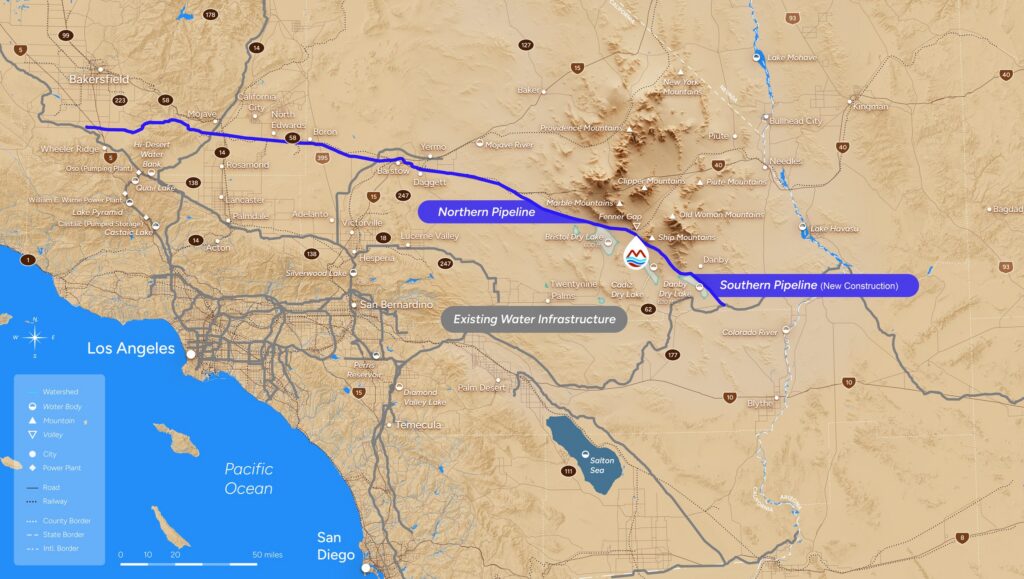
The Mojave Groundwater Bank is developing Northern and Southern Pipeline routes to reach regional water systems. The Northern Pipeline runs through San Bernardino and Kern counties. The planned Southern Pipeline connects the project to the Colorado River Aqueduct, which delivers water from the Colorado River into Riverside County, providing another route for water supply and exchanges.
The Northern Pipeline conversion received a BLM decision in July 2026 for water conveyance across BLM-managed lands. The pipeline crosses rural, underserved desert communities, including more than a dozen state-designated disadvantaged communities. Reusing it creates a route to deliver water to those communities and to regional water systems along its path.
According to Secure Water Alliance, 70 percent of Northern Pipeline capacity is reserved for Inland area water providers.
The County MOU allows its reserved water to reach the Colorado River Aqueduct or another available conveyance system. Providers can plan delivery around the route serving their communities. For the one-time allocation, the MOU specifies delivery within five years of a County request made after project construction is complete.
Additional Commitments Support Tribal Water Access
Cadiz’s community partnerships also extend to the Salton Sea Authority and Torres Martinez Desert Cahuilla Indians. Its 2022 community-water announcement pairs a planned water commitment with support for infrastructure and treatment on Tribal lands.
Cadiz’s subsidiary ATEC has already installed arsenic-removal systems at wells serving Torres Martinez administration buildings, a clinic, and community areas. ATEC’s account of the Tribal treatment installations reports that Cadiz covered the capital costs and ATEC worked with FIELD to train Tribal technicians to operate and maintain the systems. This work improves access to existing groundwater supplies while the project develops additional water-delivery infrastructure.
Frequently Asked Questions
What Does the County’s Priority Right Mean for Local Water Providers?
For supply covered by the priority provision, County public water systems can enter substitute agreements before Cadiz contracts for beneficial use outside the County. The MOU sets notice periods and requires substantially similar terms. Supply already under binding written agreements when the 2023 update took effect is outside that priority provision.
How Much Water Is Reserved Specifically Through the One-Time Allocation?
The County MOU reserves 25,000 acre-feet in total. Qualifying public providers in the Mojave watershed region can access it by notifying the County of their intent to facilitate delivery to disadvantaged communities. The County designates delivery of the reserved water.
What Delivery Costs Does Cadiz Cover for the County Allocation?
Cadiz and Fenner Gap deliver the one-time supply to the selected conveyance system at no cost to the County. The County bears environmental-review and permitting costs attributable to that delivery. Local distribution arrangements determine how the water reaches individual communities.
When Can County Communities Receive the Reserved Water?
The MOU specifies delivery within five years of a County request made after project construction is complete. Providers participate through the MOU’s notice and allocation procedures and arrange conveyance to their communities.
Related Articles
The Mojave Groundwater Bank is designed to provide clean, reliable and affordable water to underserved communities in the Southwest. Take a closer look at the science, safeguards, and community partnerships behind the project.