
U.S. Bureau of Land Management Approved the Northern Pipeline Conversion
BLM’s July 2026 decision approves converting the Northern Pipeline to water conveyance across public lands.
The U.S. Bureau of Land Management completed federal review of Cadiz’s Northern Pipeline conversion in July 2026 and approved a water-conveyance right-of-way across BLM-managed lands. The pipeline would carry supply from the Mojave Groundwater Bank. BLM’s decision establishes a federal authorization for the defined conversion, subject to its conditions; other project and route requirements remain separate.
Summary
- Cadiz acquired the 220-mile Northern Pipeline from El Paso Natural Gas in 2021. In 2023, BLM approved assignment of the existing right-of-way to Cadiz Real Estate LLC for idle-pipeline maintenance.
- On July 8, 2026, BLM signed a Decision Record and Finding of No Significant Impact following an Environmental Assessment for converting a 162-mile portion of the Northern Pipeline from natural gas to water conveyance.
- BLM’s Northern Pipeline approval covers conversion, operation, and maintenance on BLM-managed lands. It follows the Fenner Valley Water Authority’s 2025 environmental review in Addendum No. 2 under the California Environmental Quality Act.
- Federal and state reviews address different responsibilities. San Bernardino County regulates project groundwater use through the approved groundwater management plan.
- The Northern Pipeline’s planned capacity is 25,000 acre-feet per year. Approximately 22,000 acre-feet per year is contracted for delivery.
Federal Review Supports Conversion to Water Delivery
BLM’s Environmental Assessment, Finding of No Significant Impact, and Decision Record establish the federal review and authorization for the Northern Pipeline conversion. The Needles Field Office prepared the review under the National Environmental Policy Act, commonly called NEPA. BLM’s official project register records the Decision Record and finding as signed on July 8, 2026.
The three documents serve different purposes:
- Environmental Assessment (EA): Evaluates the proposed conversion and alternatives, including the affected environment and potential effects.
- Finding of No Significant Impact (FONSI): Records BLM’s determination that the defined action, including its design and avoidance measures, would not significantly affect the human environment. On that basis, BLM concluded an Environmental Impact Statement was not required.
- Decision Record: Approves the selected action and authorizes issuance of the right-of-way under Title V of the Federal Land Policy and Management Act.
Federal Approval Enables Reuse of the Northern Pipeline
The Decision Record authorizes Fenner Gap Mutual Water Company to convert, operate, and maintain the Northern Pipeline for water conveyance across public lands. Reusing an existing buried pipeline and utility corridor provides a route for moving project water with limited new surface disturbance. New facilities and construction work still require environmental review.
The approved action includes up to seven pump stations, three on BLM-managed lands, plus up to 140 air and vacuum relief valves and 140 blow-off facilities. The conversion also requires inspection and any necessary repair or rehabilitation of the existing line.
The Northern Pipeline is approximately 220 miles long. The planned conversion covers the first approximately 162 miles, from Cadiz to Mojave, California, to serve contracted deliveries. BLM’s Environmental Assessment evaluates that conversion, and its right-of-way approval applies to the portions on BLM-managed lands.
Cadiz’s July 2026 filing reports that the company received the effective federal right-of-way grant on July 14, after satisfying the remaining requirements for it to take effect.
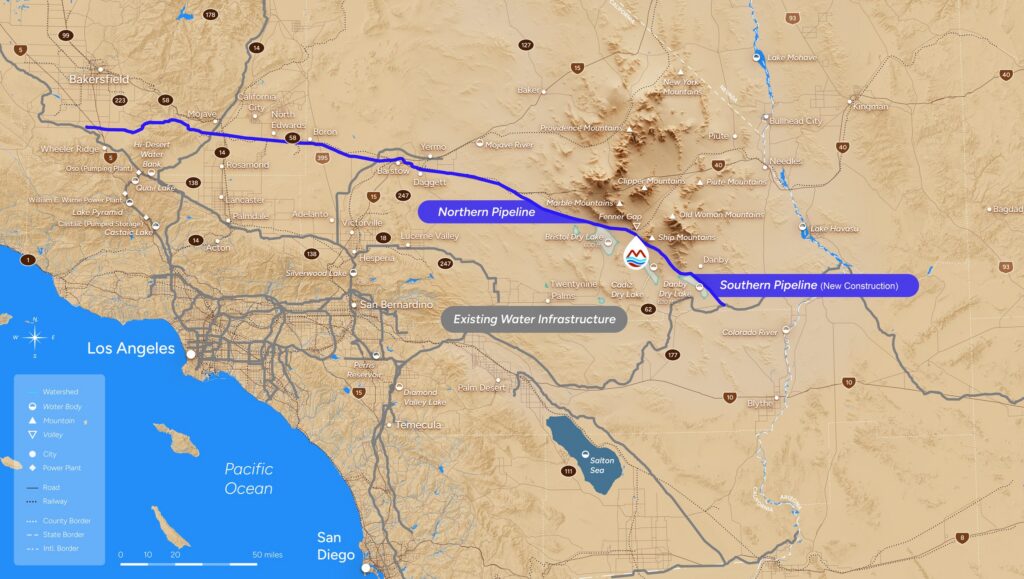
State and Federal Reviews Support Water Delivery
The Northern Pipeline’s state and federal reviews evaluate related work under different authorities. The California Environmental Quality Act, or CEQA, governs the state environmental review. NEPA governs BLM’s consideration of the federal right-of-way action.
Santa Margarita Water District certified the original project Environmental Impact Report in 2012. San Bernardino County approved the groundwater management plan that year, and California courts upheld the reviewed state approvals.
The July 2025 Northern Pipeline addendum, prepared for the Fenner Valley Water Authority, assessed the proposed conversion against the earlier environmental analysis. The addendum addresses conversion-related construction and operation, including how the Northern Pipeline would work with other project facilities.
BLM determined that groundwater-source effects fall outside the scope of its federal action and remain subject to state and local regulation. BLM cites the Supreme Court’s 2025 Seven County decision and updated Interior Department procedures to explain its jurisdiction. The federal decision also discusses the groundwater management plan and prior studies in considering protection of resources on public lands.
The project has applied to the California State Lands Commission for authorization to convey water across state-managed lands and for the finding required by California Water Code Section 1815. The application remains pending. In its August 2026 letter, Cadiz reported funding work by a contractor selected by Commission staff to review the project’s environmental record. Section 1815 directs the Commission to consider all available scientific information when determining whether the proposed water transfer will adversely affect protected natural or cultural resources. The statute provides 15 months from receipt of an application for the finding, with a possible extension to 24 months.
Key Milestones in the Pipeline’s Environmental Review
| Date | Action | Significance |
| 2020 | Gas-pipeline right-of-way renewed. | Continued the existing Mineral Leasing Act authorization. |
| 2023 | Right-of-way assignment to Cadiz approved. | Changed the holder of the existing authorization; water conversion required a separate action. |
| July 2025 | Northern Pipeline Addendum No. 2 prepared. | Assessed conversion against the earlier state environmental review. |
| July 8, 2026 | BLM Decision Record and FONSI signed following an EA. | Approved the defined conversion and authorized issuance of the water-conveyance right-of-way. |
| July 14, 2026 | Cadiz reported receipt of the effective federal right-of-way grant. | The remaining requirements for the federal grant to take effect had been satisfied. |
Federal Approval Advances the Northern Pipeline Toward Water Delivery
The Bureau of Land Management’s July 2026 decision approved conversion of Cadiz’s Northern Pipeline to water conveyance across BLM-managed lands, subject to the grant’s conditions. The pipeline’s planned capacity of 25,000 acre-feet per year, described in the July 2026 announcement, would accommodate half the Mojave Groundwater Bank’s average annual supply of 50,000 acre-feet.
The federal approval authorizes the defined conversion work with environmental protections, advancing an existing pipeline toward water delivery.
Frequently Asked Questions
What does the 2026 BLM decision authorize?
The decision authorizes issuance of a Title V right-of-way for Fenner Gap Mutual Water Company to convert, operate, and maintain the Northern Pipeline for water conveyance on BLM-managed lands, subject to the grant’s conditions.
How is groundwater use at Cadiz Ranch regulated?
San Bernardino County regulates project groundwater use through the approved Groundwater Management, Monitoring and Mitigation Plan, which establishes safeguards under the County’s Desert Groundwater Management Ordinance. BLM’s Northern Pipeline decision authorizes the pipeline conversion on federal lands; the County’s plan governs groundwater use at the project site.
Why did BLM issue a FONSI rather than require an Environmental Impact Statement?
The conversion reuses an existing buried pipeline and utility corridor, limiting new surface disturbance. New pump stations and other facilities still require construction. BLM evaluated that work with its design, avoidance and mitigation measures and found that the defined conversion would not significantly affect the human environment. The FONSI records that finding and explains why an Environmental Impact Statement was not required.
How much water could the Northern Pipeline carry?
The Northern Pipeline’s planned capacity is 25,000 acre-feet per year, half the Mojave Groundwater Bank’s average annual supply of 50,000 acre-feet.
Related Articles
The Mojave Groundwater Bank is designed to provide clean, reliable and affordable water to underserved communities in the Southwest. Take a closer look at the science, safeguards, and community partnerships behind the project.